Rounded shoulders, a head that creeps towards the screen and an ache between your shoulder blades can make you wonder how to fix bad posture. A few well-chosen posture correction exercises can help you build mobility, strength and better awareness of how you hold yourself.
But there’s no single “perfect posture” you need to hold all day. And exercises don’t always change the underlying pattern, particularly if there’s a structural issue or another reason for your discomfort. Here are seven practical movements to try at home, how to do them and when it may be worth having your posture assessed.
A quick note: These exercises are general guidance, not a diagnosis or a personalised treatment plan. Keep movements comfortable. Stop if an exercise causes sharp or worsening pain, tingling, numbness or weakness.
7 posture exercises to try at home
1. Doorway chest stretch, open the front of the shoulders
How: Stand in a doorway with one forearm resting against the frame and your elbow around shoulder height. Gently step forwards until you feel a mild stretch across your chest. Hold for 20–30 seconds, then switch sides. Repeat once.
Cue: Keep your ribs relaxed and your shoulder away from your ear.
Common mistake: Leaning so far forwards that you feel a pinch at the front of the shoulder. Ease back until the stretch feels comfortable.
2. Seated thoracic extension, mobilise your mid-back
How: Sit on a sturdy chair with its top just below your shoulder blades. Support your head lightly with your hands. Gently lean your upper back over the chair back, then return to sitting tall. Do 8–10 slow repetitions.
Cue: Let the movement come from your upper back; keep your neck relaxed.
Common mistake: Arching your lower back or tipping your head backwards to create the movement. Keep the motion small and controlled.

3. Side-lying open book, add upper-back rotation
How: Lie on your side with your knees bent and stacked, arms straight out in front of you and palms together. Keeping your knees together, slowly sweep your top arm across your body and towards the floor behind you, following it with your eyes if comfortable. Return to the start. Do 6–8 repetitions per side.
Cue: Breathe out as you open and keep your hips still.
Common mistake: Forcing your arm to the floor or allowing your knees to roll apart. Move only as far as feels easy.
4. Resistance-band row, strengthen the upper back
How: Sit or stand tall with a light resistance band secured in front of you. Hold an end in each hand, arms reaching forward. Draw your elbows back close to your sides, then slowly return. Do 2 sets of 10–12 repetitions.
Cue: Keep your shoulders away from your ears and your ribs relaxed.
Common mistake: Shrugging, jerking the band or leaning backwards to finish the pull. Use a lighter band if you can’t keep the movement smooth.

5. Wall slides, practise comfortable shoulder movement
How: Stand with your back near a wall, feet a short step forwards. Place your forearms against the wall if comfortable. Slowly slide your arms upwards, then back down, staying within a range you can control. Do 1–2 sets of 8–10 repetitions.
Cue: Keep your neck relaxed and breathe normally.
Common mistake: Flare your ribs, arch your lower back or force your arms higher than is comfortable. The movement doesn’t need to be large to be useful.
6. Chin tuck, practise a more neutral head position
How: Sit or stand with your eyes level. Without looking down, gently glide your head backwards, as if making a small double chin. Hold for 3–5 seconds, relax and repeat 8–10 times.
Cue: Think “back”, not “down”. Keep your jaw relaxed.
Common mistake: Tilting your head down or pushing hard into a wall. This should be a small, gentle movement, not a forceful stretch.
7. Dead bug, build trunk control
How: Lie on your back with your knees bent and feet lifted so your hips and knees are roughly at right angles. Gently brace your abdomen, then slowly lower one heel towards the floor and bring it back. Alternate sides for 6–8 repetitions per side.
Cue: Keep breathing and use a small range that lets you control your trunk.
Common mistake: Letting your lower back arch, holding your breath or lowering your leg too far. Put your feet down and reset if needed.

A simple 10-minute routine
Try this sequence four or five days a week. Keep the effort gentle at first, and take a short pause between movements:
- Doorway chest stretch: 30 seconds each side (1 minute)
- Seated thoracic extension: 8–10 repetitions (1 minute)
- Side-lying open book: 6 repetitions each side (2 minutes)
- Resistance-band row: 2 sets of 10–12 (2 minutes)
- Wall slides: 8–10 repetitions (1 minute)
- Chin tucks: 8–10 repetitions (1 minute)
- Dead bug: 6 repetitions each side (2 minutes)
If you’re new to exercise, start with one set and build up gradually. Regular, comfortable practice matters more than pushing through discomfort. It can also help to change position regularly during the day. For workstation ideas, see our separate guide to desk posture and pain.
How long before you notice a difference?
There’s no guaranteed timeline. Some people notice better movement or awareness within a couple of weeks; building strength and endurance generally takes longer. Give a manageable routine six to eight weeks of consistent practice before judging whether it’s helping, and pay attention to comfort and function as well as how you look.
Research reviews suggest exercise can improve some measures of forward-head and rounded-shoulder posture, but the studies vary in quality and in the programmes they use. That’s one reason a combination of mobility, strengthening and movement practice is more sensible than relying on one stretch alone. You can read a systematic review of exercise for postural alignment for more detail.
Why posture exercises sometimes don’t change the pattern
Exercises can help with mobility, strength and control. They may not be enough on their own if the posture you’re concerned about is related to a structural feature, a longstanding pattern or a different source of pain. Stretching can feel relieving, for example, without necessarily changing what is driving your symptoms or recurring stiffness.
That doesn’t mean your posture can’t improve. It means the right starting point is understanding what’s going on rather than assuming every person needs the same set of exercises. Posture is also not a fixed pose: regularly changing position and building capacity to move comfortably are useful goals.
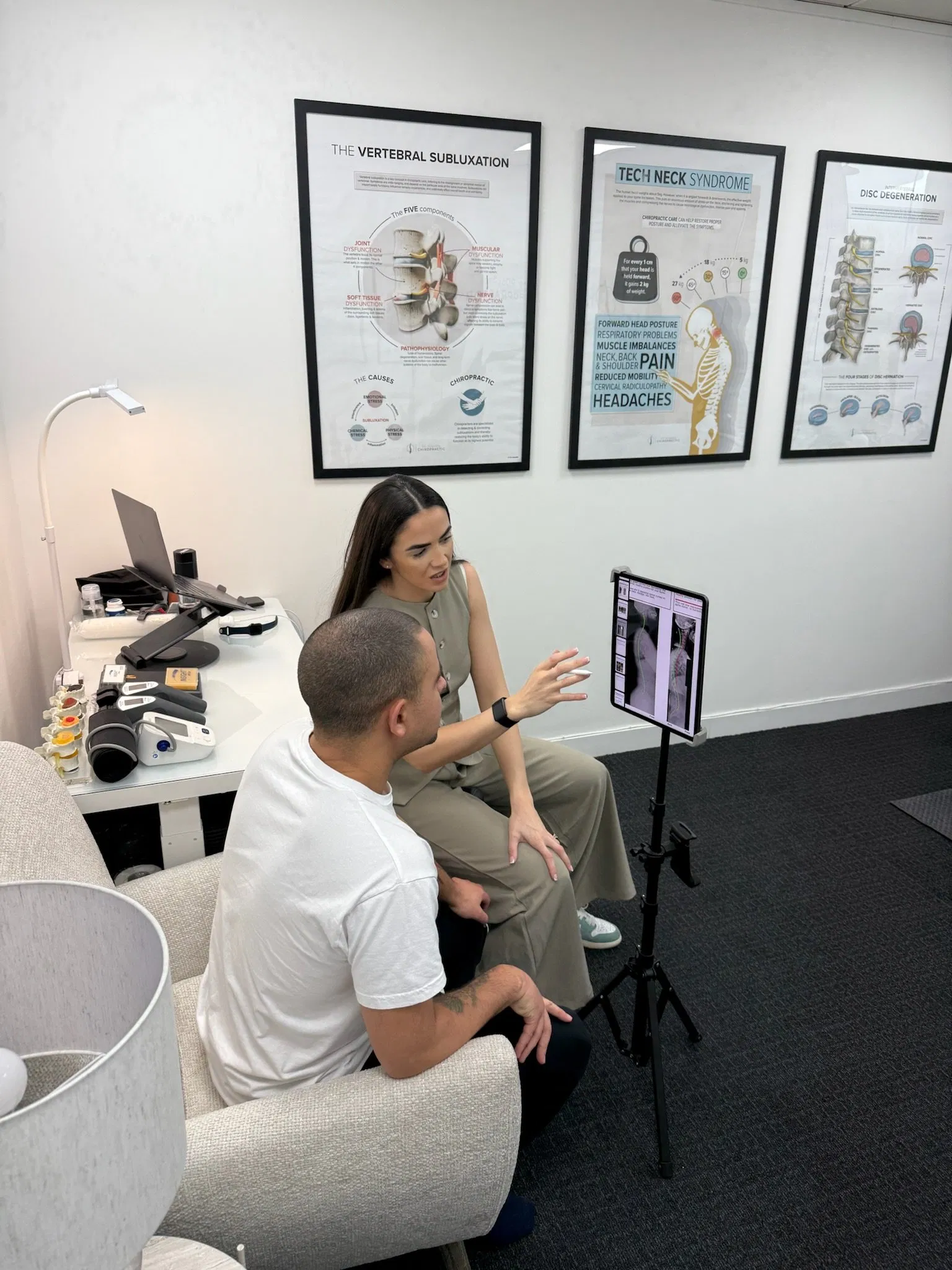
At Dr Roberta Chiropractor in Cheadle, posture assessment may include a clinical history and examination, and, where appropriate, a more detailed structural assessment. Dr Roberta uses Chiropractic BioPhysics (CBP), which includes measured postural analysis to help inform individual care plans. She is one of only 25 CBP-certified practitioners in the UK. Learn more about Chiropractic BioPhysics.
INSiGHT scans may also be used alongside your history and examination to provide additional information, such as measures relating to muscle activity and autonomic nervous system function. They are not a standalone posture diagnosis or a substitute for examination. Dr Roberta is also one of only six PX Docs-certified practitioners in the UK; this specialist training supports nervous-system-centred care.
When should you seek advice?
Consider speaking to a healthcare professional if your neck or upper-back discomfort is persistent, worsening, affecting daily activities or travelling into your arm. Seek urgent medical advice for new or progressive weakness, loss of coordination, severe sudden headache, significant symptoms after an accident, or problems with bladder or bowel control. These symptoms don’t automatically mean something serious is happening, but they should be assessed promptly.
If you’re in Cheadle, Stockport or South Manchester and would like to discuss an assessment, you can check appointment options. For more on neck-related concerns, visit our neck pain page.
FAQs about posture correction exercises
Can posture correction exercises fix rounded shoulders?
They may help by improving upper-back strength, shoulder control and chest mobility. The result depends on the individual and what’s contributing to the posture pattern; exercises don’t guarantee a particular change.
What are the best exercises for forward head posture?
A gentle chin tuck can help practise head position, while upper-back strengthening, thoracic mobility and regular movement breaks support a more balanced routine. Choose movements that feel comfortable.
How often should I do posture exercises?
A short routine four or five days a week is a reasonable place to start. Begin with low effort, build gradually and stop or adapt any movement that causes worsening symptoms.
Can exercises help with text neck?
Movement breaks and exercises for neck control and upper-back mobility may help some people manage stiffness associated with long periods looking down. Persistent or radiating pain deserves an individual assessment.
Why do my posture exercises not seem to work?
The routine may not match your needs, or it may not address a structural or other contributing factor. A tailored assessment can help clarify what’s appropriate rather than relying on generic exercises alone.
Leave a Reply